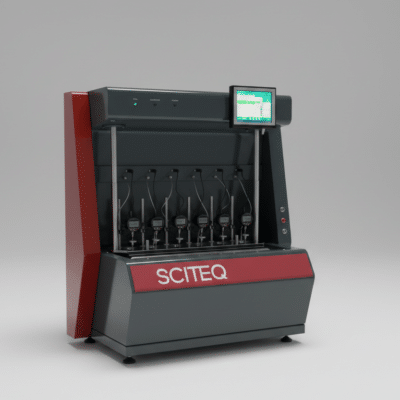
ISO 2507 specifies how to determine the Vicat softening temperature of thermoplastic pipe and fittings, particularly used for PVC-U, PVC-C.
The test standard ISO 2507 defines how to determine the Vicat softening temperature (VST) of thermoplastic pipes and fittings by measuring the temperature at which a standard needle penetrates 1 mm into the specimen under load.

ISO 2507 is an internationally recognized standard that defines how to determine the Vicat softening temperature (VST) of thermoplastic pipes and fittings. The Vicat softening temperature is the temperature at which a flat-ended needle of specified dimensions penetrates the surface of a test specimen to a defined depth under a specified load. This method is commonly used to evaluate the heat resistance of thermoplastic piping materials such as PVC-U and PVC-C. ISO 2507 is particularly relevant for manufacturers, testing laboratories, and certification bodies that need to verify the thermal performance of plastic pipe products used in construction, water supply, and industrial systems.
The standard specifies the required test apparatus, specimen preparation, and procedure for determining the Vicat softening temperature.
It describes standardized heating rates and loading conditions suitable for thermoplastic pipe materials.
It ensures that results obtained in different laboratories can be compared reliably using consistent testing parameters.
Determining the Vicat softening temperature according to ISO 2507 is important for product development, quality control, and compliance with piping product standards. The measured temperature helps confirm that pipe materials meet specified thermal performance requirements and that the manufacturing process produces consistent material properties. Because thermoplastic pipes are often used in systems exposed to elevated temperatures, this test provides valuable information about their resistance to heat and potential deformation.
ISO 2507 applies specifically to thermoplastic pipes and fittings and includes procedures for preparing specimens taken from pipe walls. While the test provides a useful indication of softening behavior under controlled conditions, it does not represent the full mechanical performance of a material at high temperatures. Results may differ from those obtained using other thermal evaluation methods, such as heat deflection temperature (HDT) tests, because each method measures different aspects of material behavior. Therefore, test results should always be reported together with the standard and test conditions used.
ISO 2507 provides a consistent and repeatable method for determining the Vicat softening temperature of thermoplastic pipes and fittings, supporting reliable evaluation of their heat resistance and suitability for temperature-sensitive applications.
The ISO 2507 Vicat softening temperature test is a standardized method used to determine the temperature at which thermoplastic pipes and fittings begin to soften under a specified load. During the test, a flat-ended needle (indenter) is pressed into the surface of a plastic specimen while the temperature is increased at a controlled rate.
The Vicat softening temperature (VST) is recorded when the indenter penetrates the material to a depth of 1 mm. This value indicates the heat resistance of thermoplastic pipe materials and helps determine whether the material is suitable for applications involving elevated temperatures.
The ISO 2507 test is commonly applied to thermoplastic piping materials such as:
PVC-U (unplasticized polyvinyl chloride)
PVC-C (chlorinated polyvinyl chloride)
Other rigid thermoplastic pipe materials
Manufacturers, testing laboratories, and certification bodies use ISO 2507 to verify that pipe products meet required thermal performance and quality standards.
Accurate ISO 2507 test results require proper specimen preparation and careful setup of the Vicat testing apparatus.
Specimens are normally cut from the wall of the thermoplastic pipe to ensure the test represents the actual product material. The sample must have a flat and smooth test surface where the indenter will be applied.
The Vicat testing system typically includes:
A temperature-controlled heating bath or heating block
A calibrated Vicat indenter with a defined tip area
A load application system
A precision temperature measurement device
Key preparation steps include:
Prepare specimens cut directly from the pipe wall
Ensure the test surface is flat, smooth, and free of defects
Condition specimens at standard laboratory temperature before testing
Calibrate the Vicat testing apparatus according to ISO 2507
Proper preparation ensures that the measured Vicat softening temperature accurately reflects the material’s thermal behavior.
During the ISO 2507 Vicat test procedure, the specimen is heated at a controlled rate, typically 50°C per hour. A standardized load, commonly 50 N, is applied vertically through the indenter onto the surface of the specimen.
As the temperature rises, the thermoplastic material gradually softens. The indenter penetrates deeper into the specimen until it reaches a depth of 1 mm. The temperature at this point is recorded as the Vicat softening temperature (VST).
This temperature represents the point at which the material begins to lose rigidity under the applied load.
To obtain accurate and reproducible results, the ISO 2507 test must follow strict procedural requirements. Small variations in specimen preparation or temperature control can significantly affect the measured Vicat temperature.
Important testing considerations include:
Maintain representative specimens from the pipe wall
Ensure accurate calibration of the Vicat apparatus
Apply the specified load vertically and consistently
Control the heating rate precisely throughout the test
Perform replicate tests to confirm repeatability
Following these guidelines ensures consistent and comparable Vicat softening temperature measurements.
The ISO 2507 Vicat softening temperature test plays an important role in evaluating thermoplastic pipes used in construction, water supply systems, and industrial piping applications.
Typical uses include:
Material verification in plastic pipe manufacturing
Quality control during production
Certification and compliance with pipe product standards
Comparison of thermal performance between pipe materials
The resulting Vicat temperature helps engineers determine whether a pipe material can withstand expected service temperatures.
The ISO 2507 standard provides a reliable method for determining the Vicat softening temperature of thermoplastic pipes and fittings. By applying a controlled load while heating the specimen, the test identifies the temperature at which the material begins to soften.
Key benefits of ISO 2507 testing include:
Standardized measurement of Vicat softening temperature
Reliable evaluation of thermoplastic pipe heat resistance
Consistent testing procedures for quality control and certification
ISO 2507 measures the Vicat softening temperature (VST) of thermoplastic pipes and fittings, indicating the temperature at which the material softens under a specified load.
The standard is mainly used for thermoplastic pipe materials, including PVC-U, PVC-C, and other rigid plastic piping materials.
The Vicat softening temperature is recorded when the indenter penetrates the specimen by 1 mm.
ISO 2507 helps manufacturers and laboratories verify the thermal resistance and quality of plastic pipe materials, ensuring products meet performance and safety standards.
We are at your disposal for any questions, comments and suggestions. We look forward to hearing from you.
Feel free to contact us using the contact form below.
We strive to answer all inquiries within 24 hours (on working days).